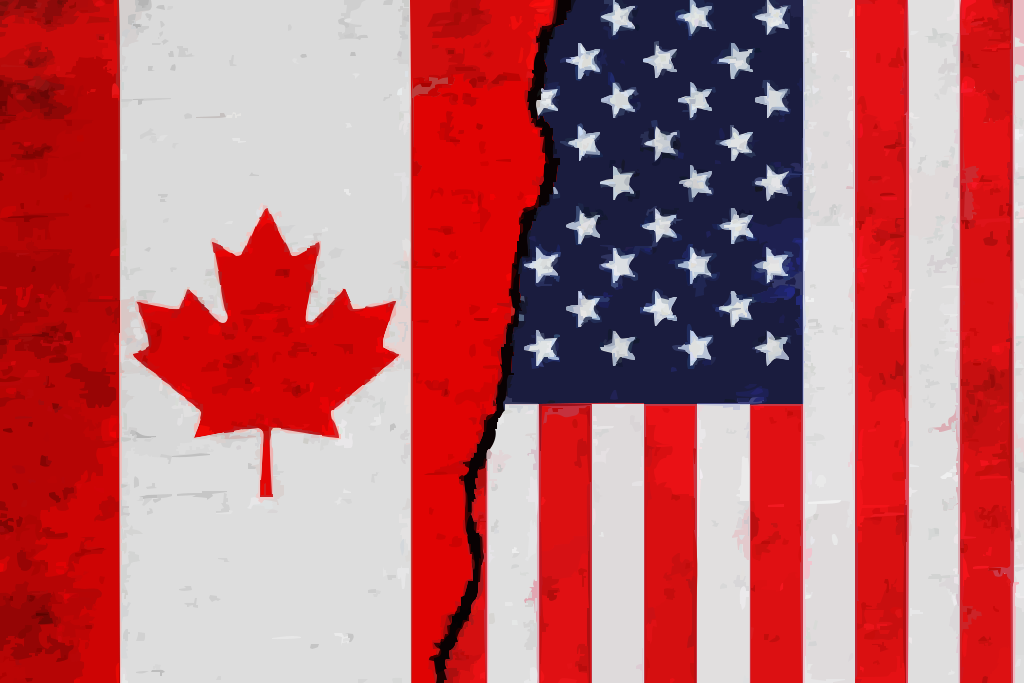
For the better part of the last year, the trade relationship between Canada and the United States has undergone a level of turbulence not seen in decades. What began in February 2025 with sweeping tariff orders by President Donald Trump has evolved into a prolonged and multifaceted trade dispute affecting industries, consumers, and communities on both sides of the border. Here is an overview of where things currently stand and what developments may lie ahead for Canadians.
How the Tariff Dispute Began
On February 1, 2025, the Trump administration signed executive orders imposing a 25 percent tariff on the majority of Canadian imports into the United States, with a 10 percent levy on Canadian energy products. The legal basis cited was the International Emergency Economic Powers Act (IEEPA), with the administration arguing that cross-border drug smuggling constituted a national emergency warranting trade restrictions.
Canada responded with its own retaliatory tariffs, initially covering approximately CA$30 billion worth of American goods and later expanding to CA$155 billion. Prime Minister Mark Carney, who took office in March 2025, maintained these countermeasures and introduced additional policies aimed at reducing economic dependence on U.S. trade, including a "Buy Canadian" procurement initiative.
The Current Tariff Landscape
As of early 2026, the situation is complex. The blanket tariff rate on Canadian goods entering the United States stands at 35 percent for products not protected by the Canada–United States–Mexico Agreement (CUSMA, known in the U.S. as USMCA). However, the CUSMA exemption has served as a critical buffer: according to reporting from early August 2025, more than 85 percent of Canada–U.S. trade remained tariff-free thanks to this provision.
In addition to the general tariffs, specific sectors face targeted duties. Steel, aluminum, and automobiles are subject to separate Section 232 tariffs of 25 percent. Softwood lumber faces an additional 10 percent tariff, and certain upholstered furniture and cabinetry products have been hit with rates as high as 50 percent. The automotive sector, in which supply chains are deeply integrated across North America, has been particularly affected.
Canada, for its part, rolled back many of its retaliatory tariffs in late August and September 2025, largely aligning with the CUSMA exemption structure in an effort to ease tensions and restart trade talks. However, Ottawa has maintained protective measures for its steel and lumber industries, including global tariff rate quotas and surtaxes designed to prevent dumping from other countries seeking to exploit the disrupted North American market.
Political Developments and Recent Escalation
The trade dispute has been marked by periods of diplomatic progress followed by sudden escalation. In January 2026, President Trump threatened a 100 percent tariff on all Canadian imports if Ottawa proceeded with a trade agreement with China involving agricultural products and electric vehicles. Separately, in February 2026 he threatened to block the opening of the Gordie Howe International Bridge, a major new border crossing between Windsor, Ontario, and Detroit, Michigan.
On the U.S. domestic front, a notable development occurred in mid-February 2026 when the House of Representatives voted 219 to 211 to terminate the national emergency declaration that had been used to justify the IEEPA tariffs on Canada. Six Republican members crossed party lines to support the resolution, reflecting bipartisan concern over the economic impact of the tariffs. The measure now moves to the Senate, which passed similar legislation in 2025. However, even if the Senate approves it, the President is expected to issue a veto, and the votes to override that veto do not appear to be available.
Meanwhile, the U.S. Supreme Court is expected to issue a ruling on the legality of using IEEPA to impose tariffs, potentially before the end of its current term this summer. Lower courts have found that the law does not authorize the President to levy tariffs, but the administration has appealed those rulings. The outcome of this case could significantly reshape the legal framework around the current trade measures.
Economic Impact on Canada
The trade dispute has had tangible consequences for the Canadian economy. Economists warned early on that sustained tariffs could push the country into recession within six months. The CUSMA exemption largely prevented that worst-case scenario: Canada's economy avoided a formal recession in 2025, though it experienced two consecutive months of contraction in April and May of that year before a modest rebound.
Specific sectors have borne the brunt of the disruption. The automotive industry has seen a historic shift, with Canada importing more vehicles from Mexico than from the United States for the first time since the early 1990s. Canadian steel, aluminum, and mineral processing industries face ongoing pressure from U.S. duties. Smaller businesses that relied on cross-border trade have been particularly vulnerable, as they often lack the margins to absorb additional costs.
Consumer prices in Canada have also been affected, both directly through the cost of imported goods and indirectly through the broader economic uncertainty. Even domestically produced goods may see price increases if the difficulties experienced by businesses trickle through the supply chain.
Beyond economics, the dispute has influenced everyday cross-border life. Canadian travel to the United States dropped by 40 percent in February 2025 compared to the previous year, and polling from that period indicated that a majority of Canadians planned to avoid U.S. travel. The potential economic loss to American tourism from reduced Canadian visitors has been estimated at approximately US$4 billion annually.
What to Watch: The CUSMA Review
Perhaps the most consequential upcoming event is the scheduled CUSMA review, with a target date of July 1, 2026. While the review process was originally intended to be a routine assessment of the agreement rather than a full renegotiation, the Trump administration has signalled willingness to walk away if certain concessions are not secured.
Economists have described the potential loss of the CUSMA exemption as a worst-case scenario for Canada. If the agreement were eliminated or not renewed, the full weight of current tariff rates would apply to the vast majority of bilateral trade. Analysts at Oxford Economics have warned that this could result in long-term economic contraction for Canada, with effects lasting several years.
There are, however, some reasons for cautious optimism. Trade experts have noted that the negative effects of the tariffs on American businesses and consumers appear to be influencing policy discussions in Washington. The nonpartisan Tax Foundation has estimated that the current suite of tariffs amounts to an average tax increase per U.S. household of roughly US$1,300 in 2026. The rollback of tariffs on certain consumer staples in late 2025, along with recent reporting about potential easing of steel and aluminum duties, suggests that the administration may be open to targeted relief.
Most forecasters expect the CUSMA review to result in a renegotiated agreement that includes some ongoing tariffs on specific sectors, particularly steel, aluminum, and agriculture, rather than the wholesale elimination of the trade framework.
Practical Considerations for Canadian Households
For Canadians wondering how to navigate the ongoing uncertainty, a few practical points are worth keeping in mind. Prices on certain goods, particularly those with heavy cross-border supply chain involvement, may continue to fluctuate. Staying informed about which products are subject to tariffs can help households make more cost-effective purchasing decisions.
Those working in trade-sensitive industries — including manufacturing, natural resources, and agriculture — should be aware that shifts in tariff policy can happen quickly. The federal government has expanded access to work-sharing programs and other support measures designed to help businesses and employees weather disruptions.
Cross-border travel, while still fully available, remains a topic to monitor. Requirements for Canadians entering the United States for extended stays were tightened in 2025, and future policy changes remain possible depending on the broader diplomatic climate.
Looking Ahead
The trade relationship between Canada and the United States is undergoing a period of significant adjustment. The coming months will likely be defined by several key factors: the outcome of the Supreme Court ruling on IEEPA authority, the progress of the CUSMA review process, and the broader political dynamics in Washington surrounding tariff policy.
While the uncertainty is understandably concerning, Canada's economy has shown resilience over the past year, aided by the CUSMA exemption, diversifying trade partnerships, and domestic policy responses. The situation remains fluid, and Canadians will benefit from staying informed as these events unfold.
This article is for informational purposes only and does not constitute financial, legal, or investment advice. Readers should consult qualified professionals for guidance specific to their circumstances.